PRESS RELEASE
23 October 2025
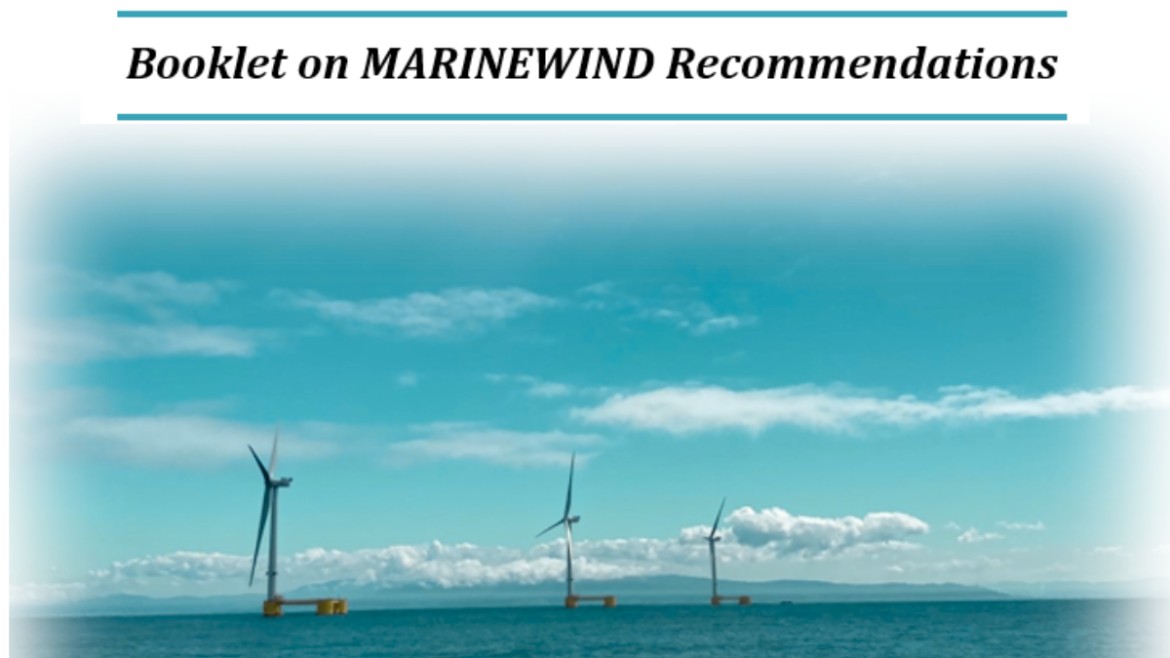
After three years of collaborative research and stakeholder engagement across five countries — Portugal, Spain, Italy, Greece, and the United Kingdom — the European project MARINEWIND has published its Booklet of Recommendations, gathering insights and lessons learned to help unlock the full potential of Floating Offshore Wind Technologies (FOWTs) in Europe.
Funded by the European Union under the Horizon Europe programme, MARINEWIND – Market Uptake Measures of Floating Offshore Wind Technology Systems set out to identify barriers and enablers for the market uptake of floating offshore wind. Through the MARINEWIND Labs (five national case studies acting as regional “laboratories of ideas”) the project analysed political, social, technological, and financial conditions affecting the development of this emerging sector. The findings culminated in a comprehensive set of recommendations tailored to the needs of a wide range of stakeholders, from public authorities, policy makers and SMEs to industry actors, citizens, and research communities. The booklet includes recommendations applicable and relevant at many European countries and tailored recommendations for country Lab specific contexts. The booklet is available in five languages (English, Italian, Spanish, Portuguese and Greek) facilitating the outreach to interested stakeholders.
The Booklet of Stakeholder Recommendations outlines six priority areas for action that can make a real difference in advancing floating offshore wind deployment:
- Promote technological innovation and upgrade infrastructure (ports, grids, and logistics);
- Build a resilient EU-based supply and value chain to reduce dependencies on non-EU suppliers and strengthen competitiveness;
- Ensure inclusive and transparent planning, integrating environmental protection, stakeholder participation, and streamlined permitting processes;
- Increase social acceptance with community-focused initiatives and local benefits;
- Adopt supportive policy and financial tools, from non-price auction criteria to investment incentives and training programmes.
- Develop a clear permitting process to promote clarity and reduce excessive duration
“These stakeholder recommendations reflect the collective expertise and collaboration that defined MARINEWIND,” said Leonidas Parodos, Project Manager at QPLAN International. “They offer practical guidance to ensure that Europe’s floating offshore wind sector grows sustainably, competitively, and with broad societal support.”
With these recommendations, MARINEWIND calls on all actors, such as policymakers, industry, researchers, and communities, to join forces in shaping a future where offshore renewable energy contributes to a fair, inclusive, and sustainable transition. By transforming shared knowledge into concrete action, Europe can turn floating offshore wind into a true driver of innovation, green growth, and energy independence.
The MARINEWIND Booklet of Recommendations, translated into the five Labs languages, is available for download.